On May 18, 2026, NIST published its summary analysis of responses on AI agent security and landed on the point many teams are already feeling in production: security concerns are now a barrier to adoption. That matters because the question is no longer whether agents will reach real systems. They already do.
The category is hardening fast. OWASP published its Top 10 for Agentic Applications in December 2025. By May 6, 2026, Censys said it had observed more than 21,000 internet-facing servers speaking MCP. Anthropic’s own documentation now tells users to connect only to remote servers they trust. Put those together and the pattern is clear: AI agent security is becoming a real category, and the center of gravity is shifting from model safety alone to execution control.
Why this category is getting real
Standards work is usually a lagging indicator. By the time NIST asks for input on a problem, the problem is already operational. In its January 12, 2026 request for information, NIST called out the distinct risk created when model outputs are connected directly to software functionality, including indirect prompt injection, poisoned models, and harmful actions taken without adversarial input. That is a strong signal that AI agent security has moved past theory and into deployment engineering.
The second signal is how the risk is being categorized. OWASP’s 2025 list for LLM and GenAI applications includes prompt injection, sensitive information disclosure, supply chain, improper output handling, and excessive agency. The 2026 agentic list narrows that further around the way autonomous systems plan, delegate, call tools, and abuse privileges. The model still matters. The part that hurts you in production is the path from model output to action.
Our read on the market is that three clusters are forming at once: discovery and posture tools that tell you where agents exist, identity layers that decide what credentials they should get, and execution-layer controls that decide whether a specific action should run right now. That last layer is where the blast radius lands. It is also the layer most teams still do not have.
What is affected
This is broader than one framework or one protocol. Any system that lets a model call tools inherits the same control problem, even if the surrounding stack looks very different.
- Coding agents in IDEs. Agents that can run shell commands, edit files, install packages, and reach local credentials.
- Framework agents. Teams building on
OpenAI Agents SDK,LangChain,LangGraph, orCrewAIwhere a model can invoke external tools as part of a workflow. MCP-connected systems. Remote servers exposing filesystems, databases, internal APIs, deployment hooks, and security tooling.- Customer-facing and internal business agents. Systems that can read tenant data, trigger workflows, approve actions, or touch regulated records.
Where legacy controls keep missing the problem
Most existing security controls were built for a human-paced operator. They inspect code before deployment, look at network edges, or review logs after the fact. Agents collapse those stages. The same session can read an untrusted document, treat a hostile instruction as relevant context, reach for a high-privilege tool, and execute the tool call before anybody notices the chain forming.
That is why prompt injection becomes more dangerous in an agentic system than in a standalone chatbot. In a chat window, a bad prompt can generate a bad answer. In an agent workflow, the same prompt can lead to a database query, a file write, a package install, a cloud action, or a credentialed API call. LLM01 and excessive agency become the same operational problem once the agent is live: they converge at the tool call.
The same shape shows up again in remote tool infrastructure. MCP is useful because it turns tools and data sources into a common interface for agents. It also concentrates trust. If the server is weakly authenticated, over-privileged, or allowed to hand the agent unsafe tool descriptions and results, the agent inherits that weakness immediately.
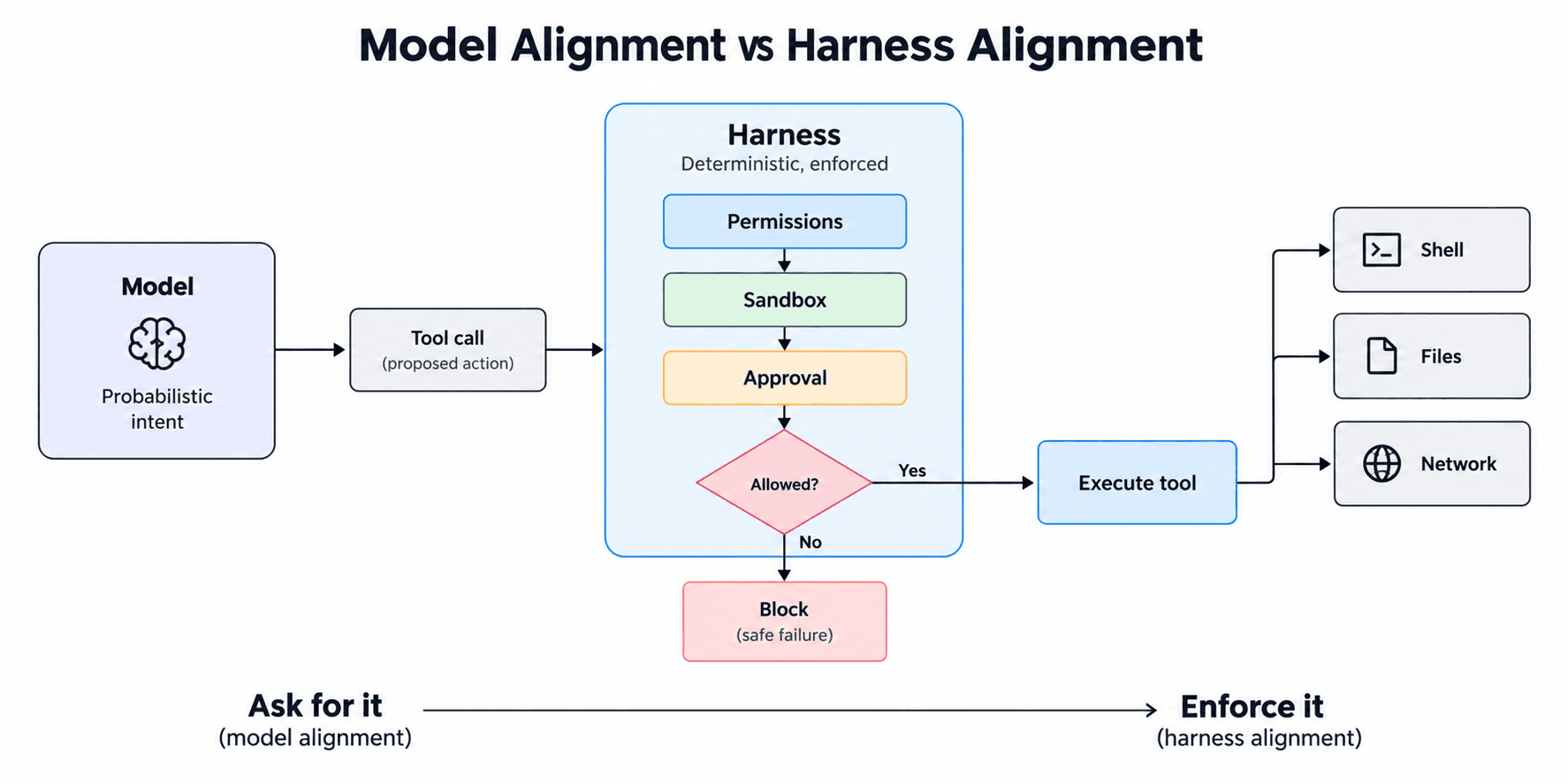
This is the practical insight behind the recent standards work: monitoring prompts is useful, auditing outcomes is useful, and identity is necessary. None of them answer the last decision. Should this exact action execute, with these arguments, for this user, in this session, against this tool, right now?
How Prismor solves the execution gap
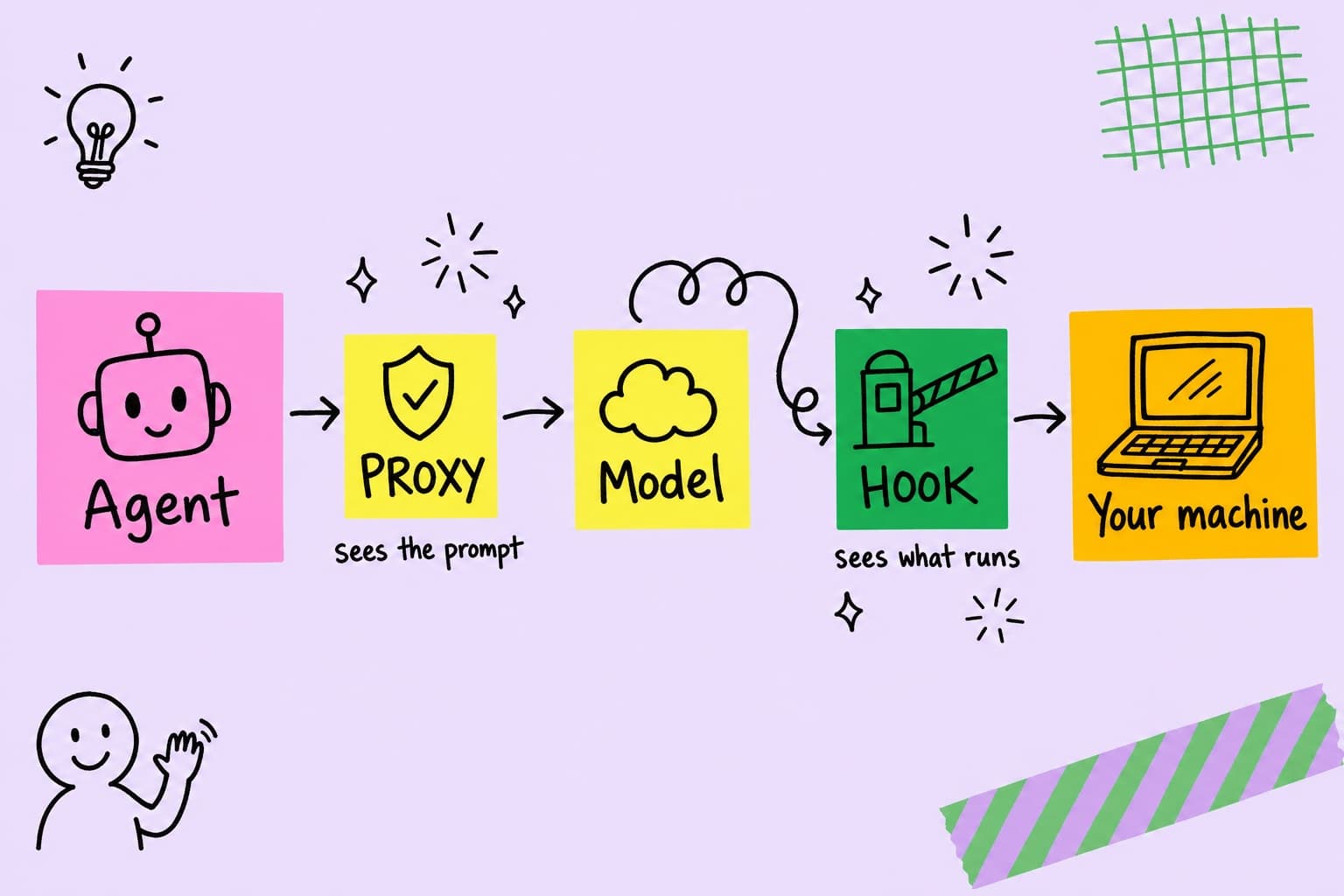
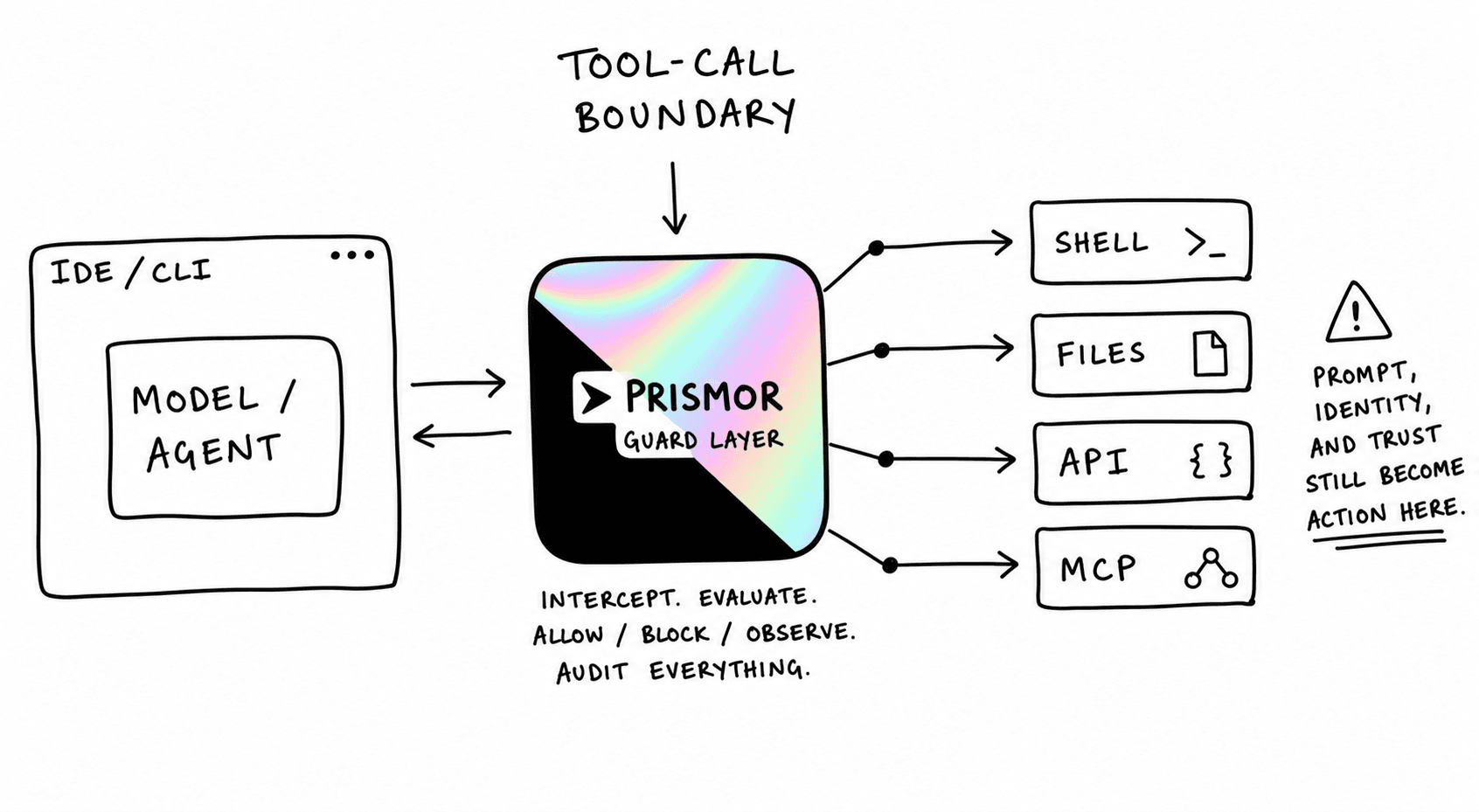
Prismor is built around that last decision. It sits between the agent’s reasoning layer and the tool it is about to execute, intercepting tool calls before they run. Instead of waiting for a shell command, file write, package install, or API call to show up in a log, Prismor evaluates the action in real time and can allow it, observe it, or block it.
The control point is intentionally thin. For framework agents, Prismor wraps the execution layer used by OpenAI Agents SDK, LangChain, LangGraph, and CrewAI. For coding agents and MCP-native workflows, it watches the same boundary where tools are invoked. Existing agent logic does not need to be rewritten to get a control plane.
That gives teams a few things they usually do not have today: per-user and per-team policy, an audit trail of what the agent tried to do, policy-as-code, and a clean path from observe mode to enforce mode. It also creates a place to express security intent in operational terms. A support agent should not write to production infrastructure. A coding agent should not exfiltrate secrets. A document agent should not call an untrusted remote tool just because a prompt told it to.
The broader point is that AI agent security needs both identity and behavior control. Credentials answer who the agent is allowed to be. Prismor answers whether the agent should be allowed to do this exact thing next. That is the missing layer in many current deployments.
What teams should do
If you are putting agents into production, the shortest useful plan is to make the execution layer visible and governable before you scale adoption.
- Inventory every tool surface. Include local shell access, file writes, package managers, internal APIs, and every
MCPserver an agent can reach. - Separate identity from action control. Short-lived credentials and scoped access matter. They do not replace a runtime decision point on tool use.
- Start with observe mode. Watch what agents do in production sessions before you lock policies down. Then move high-confidence rules to enforcement.
- Thread user context through every action. The same agent should not behave identically for every employee, customer, or workflow.
- Treat remote tool infrastructure as part of the attack surface. Trust boundaries do not end at the model or at your app server. They extend to every tool description, tool result, and remote action path the agent can consume.
The critical shift is to stop framing agent security as a model-only problem. The industry is already telling us where this goes next: more standards, more identity, more remote tools, and more autonomous actions. Teams that prepare well will be the ones with a control plane at the action layer, where an agent’s next step can still be understood, scoped, and stopped before it becomes an incident.