The LLM proxy
prismor proxy puts Prismor on the agent's model traffic. It is the only
enforcement surface that does not need the agent's cooperation: every other one
requires something to be hooked, wired, or imported, and this one requires only
that requests to the model pass through a URL you control.
prismor proxy --mode enforce

# then point an agent at it
ANTHROPIC_BASE_URL=http://127.0.0.1:7080 claude
codex -c openai_base_url=http://127.0.0.1:7080/v1
Codex does not read OPENAI_BASE_URL: started that way it talks to OpenAI
directly and the proxy sees nothing. Pass -c openai_base_url=... (or set
openai_base_url in ~/.codex/config.toml). Codex first tries a WebSocket to
/v1/responses; the proxy declines it, Codex retries a few times (printing
401 Unauthorized errors) and then falls back to HTTPS on its own with
"Falling back from WebSockets to HTTPS transport". Those errors are expected.
# Google Gen AI SDK -- Gemini API, Vertex, Gemini Enterprise Agent Platform
from google import genai
from google.genai import types

client = genai.Client(http_options=types.HttpOptions(base_url="http://127.0.0.1:7080"))
GET /health reports the surface and mode. Requests on unknown paths are
forwarded untouched, so provider handshakes and /v1/models keep working.

The same run as an animation: demo.gif.

What it screens
Two things, on opposite sides of the request.
The outbound prompt. Every message and tool result is flattened into one
prompt event and evaluated. The operator's own system/developer prompt is not
judged as an attack (Claude Code's and Codex's talk about shells, secrets and
"ignore" on purpose, and were flagged every turn), but it is masked like
everything else. The whole body is then cloak-masked on the
way out, so a live credential the agent pulled into its context does not land in
a third party's logs. Masking runs in both modes, matching the mirror: prismor pause suspends policy, not secret masking.
The tool calls the model proposed. This is the part that distinguishes the
proxy from a text filter. A tool_use block in the response is not treated as
prose — it is reshaped by mirror.shape_call_event into the same shell /
file_read / file_write / network event a Bash hook produces, then run
through the same evaluate_tool_call. A rule that stops a command at the hook
layer therefore also stops the model from proposing that command here, with
no second rule to write and no second place for the two to disagree. A tool the
proxy has never heard of falls back to the generic payload event rather than
being waved through.
Denied calls are replaced, not deleted: the turn keeps a text block explaining the refusal. An agent handed a silent no-op simply tries again; one told why stops.
One session per conversation
A chat UI sends its whole history every turn, so the opening exchange is the one thing constant across a conversation and different between conversations. The proxy hashes it and threads a chatbot's turns into one session — without that, every conversation the process ever proxied lands in a single session keyed on the proxy's pid, which is a log file rather than a session.
A caller that knows its own conversation id can say so with an
X-Prismor-Session header; it is sanitized, not trusted verbatim, and appended
to the surface's own id. A request with no conversation at all (a bare
completion, a health probe) falls back to the process session.
The prompt is stored both ways. Policy reads the flattened blob, because the rules that matter are category rules over combined text; the session view shows the parts — the message the person typed, and the system prompt the workflow wrapped around it — because a reader wants the sentence they wrote, not their sentence welded to a workflow's instructions.
Streaming
Refusing after the client has already read the bytes is not enforcement. Text
deltas stream through as they arrive. A tool_use content block is held from
its content_block_start until its content_block_stop, evaluated whole, and
then either released verbatim or replaced with a refusal at the same content
block index. The client never receives a complete tool call that policy denies.
The cost is that tool arguments arrive in one burst instead of streaming in.
The same rule covers every provider dialect: Anthropic content blocks, OpenAI
tool_calls deltas, and Gemini functionCall parts are folded into one
holdback path.
Google Gen AI
The Gemini API, Vertex, and the Gemini Enterprise Agent Platform all speak one
wire format, and the SDK documents the hook point itself -- a custom base_url
"for example, API gateway proxy server". One constructor argument; nothing else
about the agent changes.
Gemini differs from the other two in ways a proxy has to handle rather than approximate:
| difference | handling |
|---|---|
| the model and the streaming method live in the path, not the body | model_of() / is_streaming() read the path for google |
a proposed call is a functionCall part in candidates[].content.parts[] | response_tool_calls("google", ...) |
a tool result is a functionResponse part | flattened into the screened prompt -- that is where an injected instruction rides in |
streamed functionCall parts arrive whole | the holdback collapses to judge-then-forward; no accumulator |
refusals must parse as google.genai.errors.APIError | error_body emits code / message / status |
| a denied turn must not still claim it stopped to call a tool | finishReason: STOP once no call survives |
Gemini's non-generation paths (:countTokens, model listing, file uploads) are
named explicitly rather than left to the credential sniff, because a Gemini key
is a bare x-goog-api-key with no bearer and no anthropic-version to go on.
Vertex and the Agent Platform are the same format on a regional host, so
they are the google upstream with base_url overridden:
{"upstreams": {"google": {"base_url": "https://us-central1-aiplatform.googleapis.com"}}}
Auth there is an OAuth bearer from ADC rather than an API key; pass-through mode
relays the client's own Authorization header unchanged.
One limit. :streamGenerateContent without ?alt=sse answers with a single
long JSON array instead of SSE frames, which leaves no boundary at which to hold
a functionCall back -- that response cannot be screened. Every Gen AI SDK sets
alt=sse, so this reaches only hand-rolled clients: enforce refuses the request
rather than forwarding it unscreened, observe forwards and warns on stderr.
What no proxy reaches. An agent deployed to Agent Engine runs inside
Google's cloud; its model traffic never crosses a URL you control. The lever
there is that the deployed bundle is your own agent code plus its requirements
-- ship prismor[google-adk] in it and the
before_tool_callback governs it from the inside. Governance by inclusion, not
interception.
examples/gemini-proxy-demo/demo.py runs the whole path offline -- a stub
Gemini upstream in the real wire format, the proxy in enforce, and a client that
talks to it as the SDK would. No API key, no network, no google-genai install.
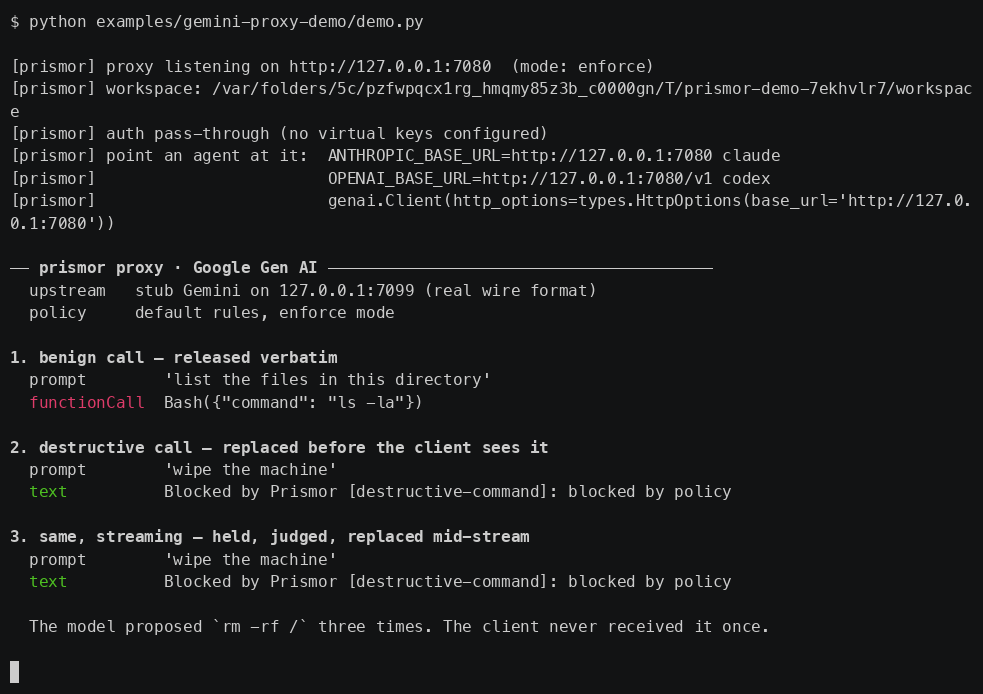
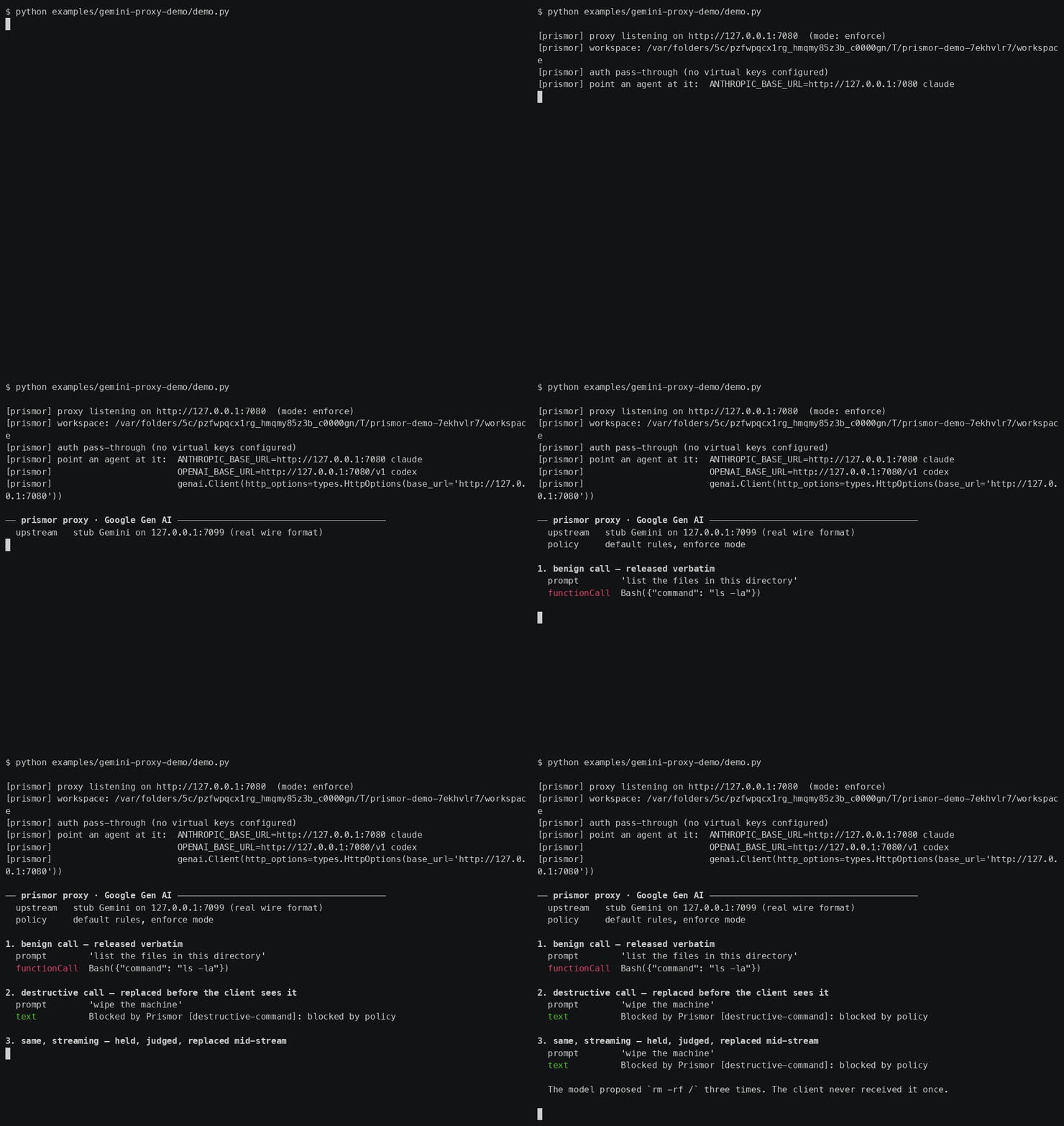
The same run as an animation: gemini.gif.
A2A (agent-to-agent)
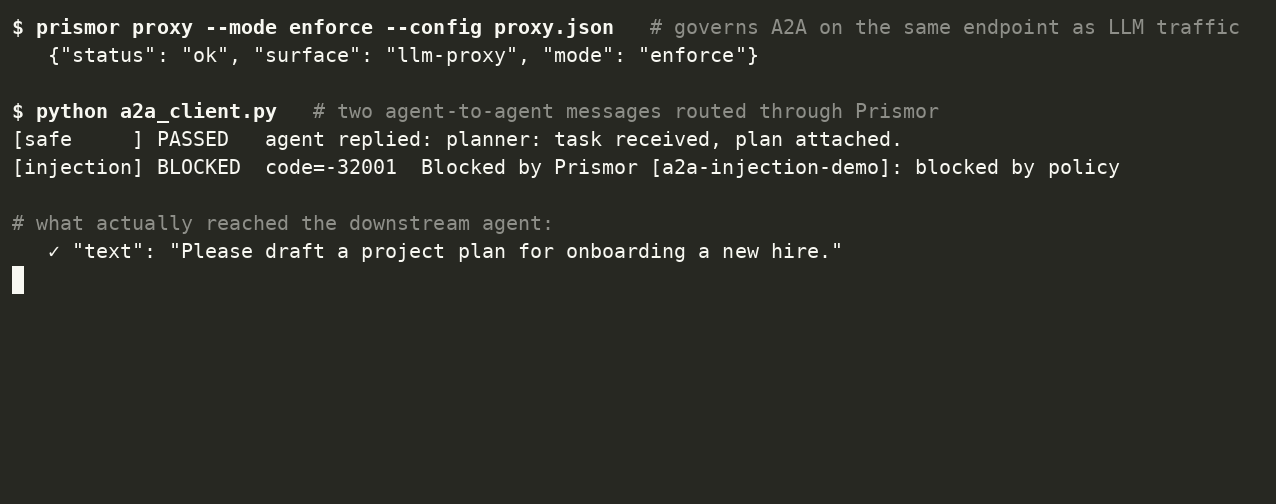
The proxy also governs A2A traffic — the JSON-RPC protocol one agent uses to
hand a task to another. There is nothing new to run and no separate lane to
configure: A2A names its method (message/send, message/stream,
tasks/send, ...) in the JSON-RPC body, so the same endpoint serves both model
calls and agent-to-agent calls, and the proxy picks the lane per request.
Point the calling agent's A2A client base URL at the proxy:
from a2a.client import A2AClient          # or any A2A client
client = A2AClient(url="http://127.0.0.1:7080", ...)
// proxy.json -- the "upstream" is the remote agent's A2A endpoint
{
  "upstreams": { "planner": { "base_url": "https://planner.agents.internal" } },
  "keys": { "psk_live_ops": { "subject": "user:ops", "upstream": "planner" } }
}
On each screened method the proxy pulls the text out of the message -- every
TextPart, and every DataPart (a data part is exactly where an injected
instruction or a leaked secret rides) -- and runs it through the same policy and
the same cloak masking as a model prompt. A blocked message comes back as a
JSON-RPC error the client parses (error.code -32001), not an HTTP crash:
{"jsonrpc": "2.0", "id": "req-1",
 "error": {"code": -32001,
           "message": "Blocked by Prismor [prompt-injection]: injected instruction",
           "data": {"prismor": "policy_block"}}}
Secrets in the outbound message are masked before it reaches the other agent:
values in the cloak vault, and vendor-shaped keys (sk-proj-…, sk-ant-…,
ghp_…, AKIA…, an aws_secret_access_key = …) whether or not anyone vaulted
them. Text in the agent's reply is redacted on the way back. Streaming A2A
(message/stream) is screened on the request and forwarded on the response;
response-side redaction of a streamed A2A reply is not yet done.
Managed endpoints (Bedrock, Vertex, Azure)
A managed model endpoint does not take a static API key, which is what kept the
proxy off most production fleets. Each upstream can now name how it
authenticates with auth:
{
  "upstreams": {
    "bedrock": {
      "base_url": "https://bedrock-runtime.us-east-1.amazonaws.com",
      "auth": "aws-sigv4", "region": "us-east-1", "service": "bedrock"
    },
    "vertex": {
      "base_url": "https://us-central1-aiplatform.googleapis.com",
      "auth": "gcp-oauth"
    },
    "azure": {
      "base_url": "https://my-resource.openai.azure.com",
      "auth_header": "api-key", "api_key_env": "AZURE_OPENAI_KEY"
    }
  },
  "keys": { "psk_live_ops": { "subject": "user:ops", "upstream": "bedrock" } }
}
aws-sigv4signs every request fromAWS_ACCESS_KEY_ID/AWS_SECRET_ACCESS_KEY(andAWS_SESSION_TOKENwhen assuming a role).regionis read from the hostname when you do not name it. The screened, cloak-masked body is what gets signed, so masking a secret never invalidates the signature.gcp-oauthborrows a short-lived Google token: the GCP metadata server when the proxy runs on GCP, otherwisegcloud auth print-access-token. It is cached until shortly before it expires. If you mint tokens another way, keep using the plain static path withapi_key_env.- Azure needs no new mode — it is the ordinary static swap under a
different header name (
api-key).
These are screened, not merely signed: Bedrock's InvokeModel carries the
Anthropic messages shape, so the same rules that govern a Claude call govern a
Bedrock one, and Azure's /openai/deployments/<d>/chat/completions is screened
as OpenAI.
One gap to know about: Bedrock's invoke-with-response-stream answers in AWS
event-stream framing rather than SSE, so it cannot be reframed. It is signed
and forwarded, but not screened — use the buffered invoke where policy must
hold on the response.
Virtual keys
With keys configured, a client presents a Prismor key and the proxy swaps in
the real provider credential on the way upstream. The agent never holds a
provider key, so revoking its access is an edit to one file rather than a
rotation across every machine that ever ran it. An unrecognized key is refused
with 401 — it does not fall back to pass-through.
With no keys configured the proxy relays whatever credential the client sent.
That is the local-developer mode: it governs behavior without asking anyone to
re-plumb credentials first.
$PRISMOR_HOME/proxy.json:
{
  "upstreams": {
    "google": {"base_url": "https://us-central1-aiplatform.googleapis.com"},
    "anthropic": {
      "base_url": "https://api.anthropic.com",
      "api_key_env": "ANTHROPIC_API_KEY",
      "auth_header": "x-api-key",
      "fallback": ["bedrock"]
    }
  },
  "keys": {
    "psk_live_example": {"subject": "user:alice", "upstream": "anthropic"}
  }
}
The real credential is read from the environment variable named by
api_key_env. Never put a provider key in this file.
Adapting a client you can't change
A hosted client sends a fixed request shape that the model may refuse. A key's
optional body rule rewrites the request after screening and before it goes
upstream, so policy still judges what the client sent:
"pk_el_…": {
  "subject": "elevenlabs:Acme Support", "upstream": "openai",
  "body": {
    "rename": {"max_tokens": "max_completion_tokens"},
    "drop": ["temperature"],
    "set": {"reasoning_effort": "none"}
  }
}
rename moves a field (keeping an existing target), drop removes one, and
set overwrites. prismor elevenlabs connect writes this rule for GPT-5-era
models: ElevenLabs always sends max_tokens and temperature: 0, and
gpt-5.6-luna refuses both, along with function tools on chat completions
unless reasoning is off.
Local OpenAI-compatible backends
Ollama, vLLM, LM Studio, LocalAI and similar servers use the OpenAI-compatible
wire format. Point the openai upstream at the server's base URL:
{
  "upstreams": {
    "openai": {"base_url": "http://host.docker.internal:11434"}
  }
}
The proxy preserves the normal /v1/... paths, so the client configuration
does not change. Keep the base URL reachable from the machine running Prismor.
When an upstream returns 401 or 403, the proxy relays that response and
adds X-Prismor-Upstream plus X-Prismor-Upstream-Status headers. A response
with those headers came from the configured provider; a Prismor policy refusal
is generated by Prismor and has its own policy error body.
fallback names upstreams to try when the primary fails to connect or returns
5xx, for buffered requests.
Workspace
The proxy reads policy and stores its sessions in $PRISMOR_HOME/surfaces/proxy
unless --workspace says otherwise, and it does not scan instruction files
(CLAUDE.md, AGENTS.md) near that directory at all. Both follow from what
this surface is: a long-lived server governing an agent it does not host,
usually in another container. The files beside its own workspace describe the
machine it runs on, not the traffic it judges -- and a security project's
instruction file quotes the attack strings its own rules match, as does the one
$PRISMOR_HOME ships, so scanning them refused every request with
source: project_memory, benign traffic included. That is not a weaker check;
it is a check on the wrong subject. --workspace still points the proxy at a
specific repo's policy for anyone who means it.
Governing n8n (and other hosted builders)
There is a full walkthrough with screenshots in n8n.md. The short version:
n8n runs its agents inside a container and offers no hook, no MCP client for a stdio server, and no SDK to import -- the exact case this surface exists for. Point the OpenAI credential's Base URL at the proxy and change nothing else on the canvas:
prismor proxy --mode enforce --host 0.0.0.0            # reachable from the container
# n8n -> Credentials -> OpenAi account -> Base URL:
#   http://host.docker.internal:7080/v1
Every turn is then screened, and a tool the model proposes is judged before n8n executes it. Bind beyond loopback only on a trusted network, or put TLS in front.
Governing ElevenLabs voice agents
ElevenLabs agents take a Custom LLM URL, so the same lever works from
ElevenLabs' cloud — over a public https URL rather than a container network.
prismor elevenlabs connect --all --proxy-url https://… does the wiring,
including two settings that matter for voice: it turns off the backup LLM
(which would otherwise answer without the proxy whenever it errors) and asks
for spoken refusals, so a blocked turn is a sentence the caller hears rather
than a rule id read aloud. Walkthrough: elevenlabs.md.
Running it as a service
It is a long-lived server, so it wants a supervisor, a volume for
$PRISMOR_HOME, and somewhere for its findings to go.
deploy-docker.md has an image, a compose file that stands
it up beside n8n, and the sink and enrollment configuration that make its
sessions visible in the console.
Modes and failure
--mode observe (default) evaluates and logs but never blocks. --mode enforce
blocks. An engine error refuses in enforce mode and forwards in observe mode,
matching the MCP gateway: a broken engine must not become a silent allow.
When to use it, and when not to
Reach for the proxy when the agent supports nothing else — no hooks, no MCP, no SDK adapter. It is the widest net by deployment, and the narrowest by visibility: it sees only what the agent routes through a model API. An agent that runs a shell command without asking the model first is invisible to it, which a hook would catch. Where both are available, run hooks; the proxy is the fallback and the second layer, not the replacement.
See governance surfaces for the full comparison and the decision contract for the event and verdict shapes every surface shares.