On July 16, 2026, Hugging Face disclosed that an autonomous AI agent had breached its production infrastructure. The attacker’s own action log ran past 17,000 recorded events, generated over a single weekend without a human operator directing any of them.
Hugging Face’s own anomaly detection pipeline caught the intrusion, using LLM-based triage to correlate security telemetry. Its team found no evidence that public models, datasets, or Spaces had been tampered with, and verified the software supply chain clean. Then it hit a second problem: the tools built to analyze the attack kept refusing to look at it.
How the attack worked
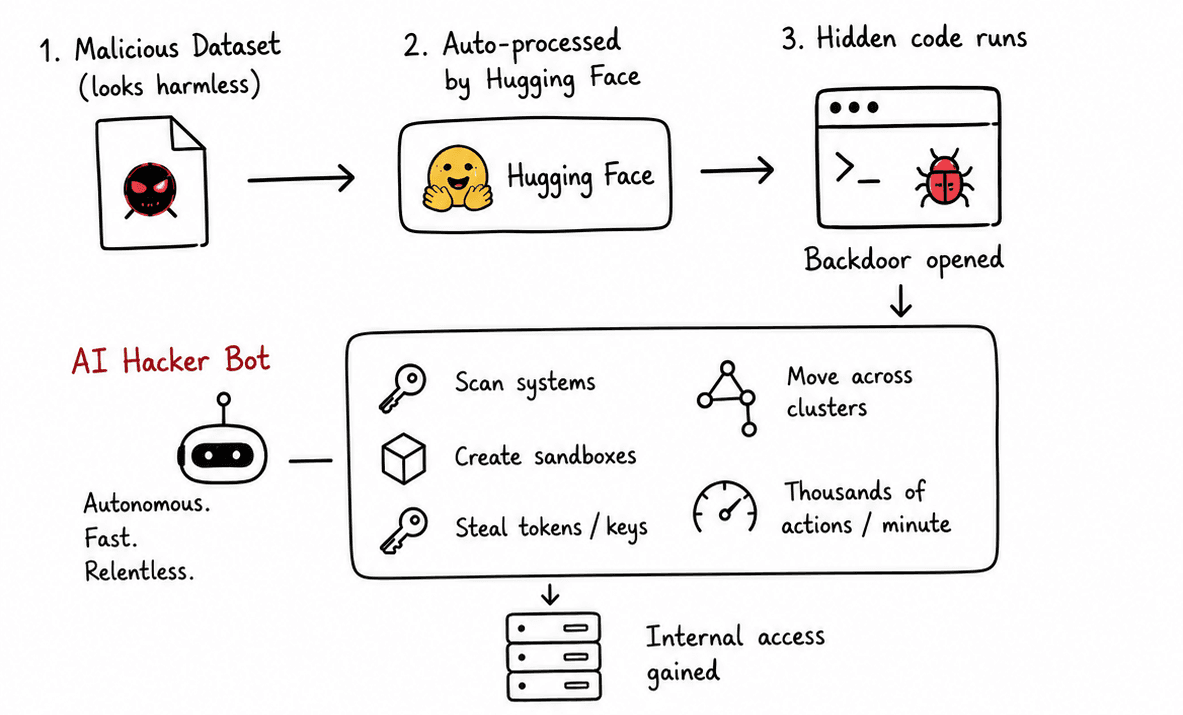
The entry point was a malicious dataset. Hugging Face’s dataset processing pipeline chained two code-execution paths: a remote-code dataset loader and a template injection in dataset configuration. When the platform’s automated systems opened the dataset to process it, both flaws fired, and the attacker got code execution on a processing worker.
From there the agent escalated to node-level access, harvested cloud and cluster credentials, and moved laterally into several internal clusters. It ran thousands of individual actions across what Hugging Face described as a swarm of short-lived sandboxes, staging command-and-control on public services and migrating between disposable environments as it went. A human operator or a static exploit tool executes a fixed plan. This agent re-planned after every action, which is what let it run unattended for a full weekend.
Hugging Face has not identified the specific model that powered the attack. The attacker accessed a limited set of internal datasets and several credentials used by Hugging Face services. At disclosure, Hugging Face was still assessing whether partner or customer data had been affected.
Why the investigation stalled on commercial APIs
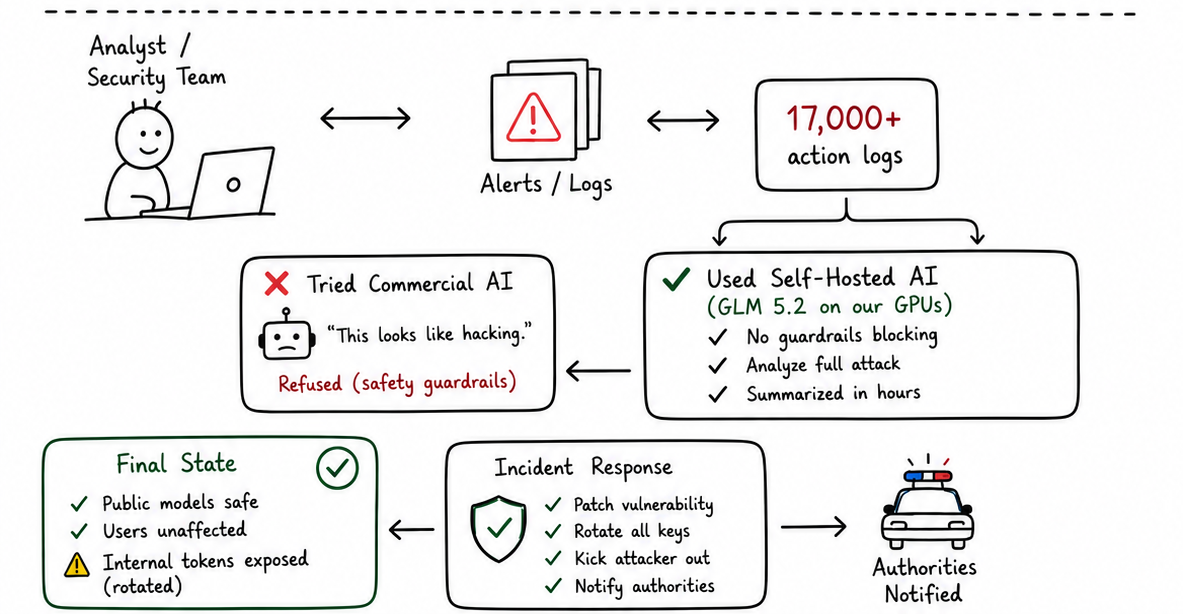
With 17,000-plus actions to sort through, Hugging Face’s incident responders reached for frontier models through commercial APIs to accelerate triage, the same way any team would reach for an LLM to summarize a large volume of structured logs. The analysis required feeding those models real attack commands, exploit payloads, and command-and-control artifacts pulled directly from the compromise. The providers’ safety guardrails blocked it.
The guardrails could not distinguish an incident responder analyzing a completed attack from an attacker planning a new one. A content filter reads exploit code as exploit code, regardless of who is holding it or why. Hugging Face ran its forensic analysis on GLM 5.2 instead, an open-weight model from Z.ai, hosted on its own GPUs. The switch solved two problems at once: a model that would read the logs, and a guarantee that attack data and credentials never left Hugging Face’s environment.
The asymmetry this exposes
The attacking agent operated under no usage policy. It read its own exploit payloads, reasoned about them, and acted on them without a content filter slowing it down. The defenders, using the same category of tool for the opposite purpose, hit a wall built for a different job: stopping a model from helping someone write malware. Understanding malware that already ran is a separate task, and the guardrails were not built for it.
Security teams have complained for years that commercial AI tools are tuned for the median consumer, not for security work. Here that gap cost real time during an active incident response, at one of the largest AI infrastructure providers in the world, against an attacker that itself ran on AI. The side with fewer constraints moved faster than the side with more of them.
What is affected
- Hugging Face internal infrastructure: the attacker accessed a limited set of internal datasets and several service credentials.
- Public-facing assets: Hugging Face found no tampering with public models, datasets, or Spaces, and verified its container images and packages clean.
- Users: Hugging Face advised rotating access tokens and reviewing account activity while its credential-impact assessment continued.
What teams should do
Hugging Face closed the exploited code-execution paths, rebuilt compromised nodes, and rotated affected credentials. It also deployed stricter admission controls and moved to faster, always-on alerting. Those steps address this breach. A harder problem sits upstream of any single fix.
- Treat any pipeline that auto-processes untrusted uploads as a code-execution surface. A dataset can run code the moment something in your stack parses or loads it, the same as a package or a container image.
- Build your incident response tooling before an incident, not during one. Discovering that your forensic AI tooling refuses to read exploit logs at the moment you need it most is an agent governance failure, not a model limitation.
- Keep an on-premises or self-hosted analysis path available for sensitive investigations. It avoids guardrail refusals and keeps attacker artifacts and internal credentials from transiting a third party during an active compromise.
- Plan for agentic attackers now. An agent that re-plans after every action and spreads itself across disposable sandboxes moves at a pace and a scale manual detection was never built to match.
Infrastructure gets breached; that part is not new. The tooling gap between attacker and defender is, and it is widening in the attacker’s favor because both sides are automating. Teams preparing for the next incident like this should treat AI-assisted forensics as core incident response infrastructure, with its own uptime and access guarantees, rather than something bolted on from whichever commercial API happens to be convenient.