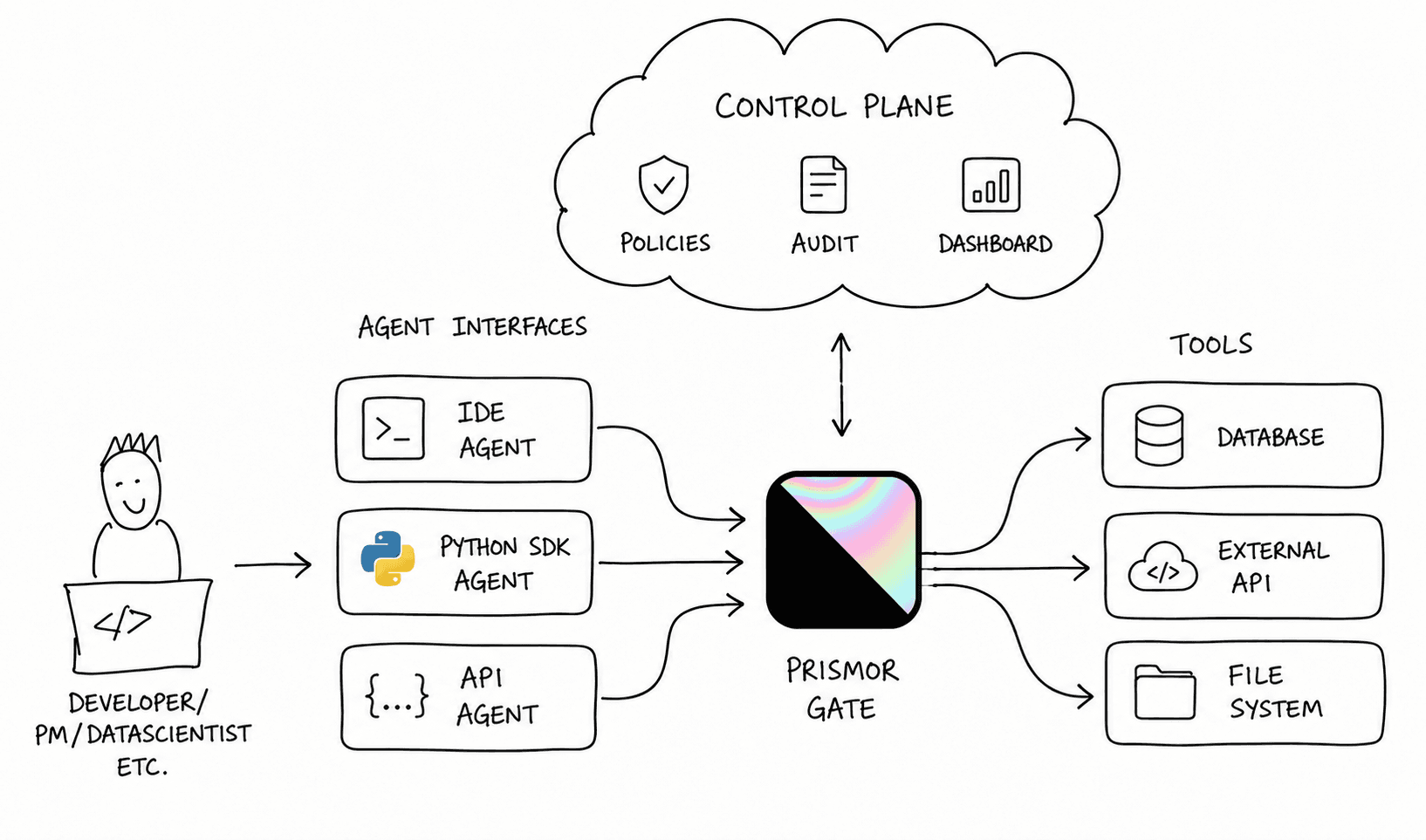
Enterprises are past the question of whether to deploy AI agents. The live question is how to keep thousands of them inside the lines. That is what a control plane does: it gives a security team central visibility, policy enforcement at runtime, and proof of what every agent did on whose behalf. Building one is an engineering project, and a few early decisions determine whether it holds under real conditions.
The tempting shortcut is to buy your cloud provider’s version and map each control to a service you already run. Identity becomes their IAM. Audit becomes their cloud trail. Guardrails become a feature of their model platform. It reads clean in an RFP and satisfies the control taxonomy. It also governs a single boundary: the traffic that crosses that one platform. Enterprise agents work past that boundary all day. A coding agent on a developer laptop runs a shell command against the local filesystem. A research agent calls three third-party SaaS tools and a self-hosted MCP server inside one session. Those actions generate no event the platform can read. A control plane worth trusting has to reach the place where the agent acts, and that single requirement drives every build decision below.
Start with an inventory
The first thing an auditor or an incident responder asks is how many agents you run and what tools each one can reach. Most enterprises cannot answer. That gap is where you begin, because every control downstream of it is guesswork until it closes.
Build a registry that names every agent in the estate: the coding agents on engineer machines, the framework agents in production services, the embedded assistants inside SaaS you bought. For each one, record the tools and MCP servers it can call and the human or service identity it acts for. Agents that register their tool roster at startup keep this list current instead of letting it rot into a stale spreadsheet. An inventory sounds like table stakes, and it is the control most organizations skip. When “the AI did it” is the only answer available after an incident, you have a governance program on paper and no control in fact.
Put the gate where the agent acts
The decision that shapes the whole build is where enforcement runs. An agent can be watched at four boundaries, and each one sees a different slice of what the agent does. A reverse-proxy gateway sits between the agent and remote APIs. It reads full payloads and binds corporate identity well, and it goes dark on any local shell command, because that command never touches the network. A kernel sensor sits at the system-call layer. It resists tampering and cannot be switched off from an app config, and it reads a stream of syscalls where a malicious sequence looks much like a legitimate build. An out-of-band scanner polls cloud and SaaS APIs on a schedule. It covers everything it can reach through OAuth and reports posture after the session has already ended.
The boundary that holds for enterprise coding and framework agents is the runtime hook: a gate inside the agent’s execution loop, ahead of the tool. It reads the action before the process spawns, which is the position from which you block a destructive command rather than log it afterward. It sees the local shell, the file write, the package install, and the agent’s intent for the call. A gate this close to the call has to stay fast enough that teams never feel pressure to bypass it, so blocking a dangerous action stays viable instead of arriving too late to matter.
Two properties make the gate trustworthy under pressure. It has to carry session state, so it knows an agent already read untrusted content before it evaluates that agent’s next write-and-send. An agent that can read untrusted input, write to disk, and reach the network holds three permissions that each pass review alone and form an exfiltration path together. A gate that inspects one call at a time approves all three and misses the combination. The gate also has to survive streaming, because agent frameworks stream partial responses by default and any control that fires only on a complete response fails open under load.
Make trust provable
Most governance stacks ask a reviewer to trust a log. An append-only file states that an agent called a function. In a dispute that is a weak artifact. An engineer who says the agent “only upgraded one library” and a log that says the same thing carry equal weight, which falls short of what an auditor in a regulated industry accepts.
Build the audit trail so it proves behavior on its own. Sign each action with a per-device key over a hash of the action, the agent identity, and a timestamp, then chain each receipt to the one before it. Now the record shows that this agent, on this enrolled device, took this action at this time, in a sequence no one edited after the fact. An Ed25519-signed chain answers the accountability controls in ISO/IEC 42001 and the OWASP Agentic Top 10 with evidence a reviewer can verify.
This property earns its cost the moment your estate spans more than one platform. With a hosted model, a self-hosted model, a laptop coding agent, and a partner’s SaaS all in play, no single provider’s trail covers the full path an action traveled. Signed execution records travel with the agent, so proof follows the workload across providers rather than living inside any one of them. Handle secrets the same way: cloak a credential into an opaque token before it reaches the model, and the agent never holds the real value to leak in the first place.
Match the rigor to the autonomy
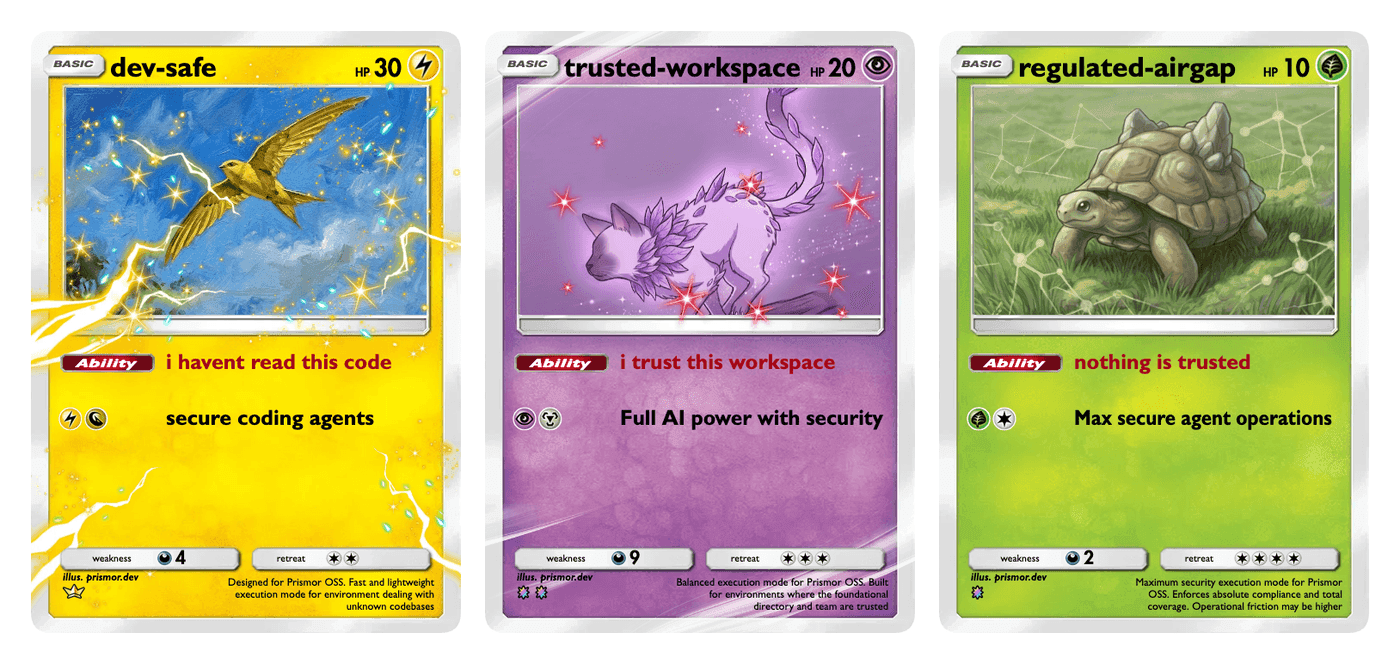
Running one control level across every agent creates friction where it is too heavy and exposure where it is too light. Scope the rigor to how much the agent can do on its own. A read-only assistant that summarizes documents needs guardrails on what it can see. An agent that modifies production configuration needs a gate on every state-changing call. The dividing line is decision authority: an agent that can change state without a human approving that specific action sits at a higher autonomy tier and earns heavier controls, whatever the procurement paperwork called it.
The policy itself should compose in layers that resolve at the same gate: an org-wide floor no team can drop below, team and per-user rules on top, and per-session scope for the task at hand. Adjusting a user’s policy should take a config change and never a redeploy. Roll enforcement out the way buyers accept it, starting in observe mode so teams see what would have been blocked before you switch any rule to enforce. Give escalation real positions: step up and wait for approval, defer into an async review queue, or deny outright, and fail closed when the approval path is unreachable.
What teams should do
Build the control plane this way and compliance falls out of the engineering instead of running beside it. The controls that satisfy ISO 42001, NIST AI RMF, and the OWASP Agentic Top 10 are the same controls that stop a real incident.
- Build the inventory first. Name every agent, its tools and MCP servers, and the identity it acts for, before adding any other control on top.
- Enforce at the runtime hook. Put the gate inside the agent’s execution loop, ahead of the tool call, where session state and streaming responses are both visible.
- Sign and chain the audit trail. A per-device signature over each action, chained to the one before it, turns a log into evidence instead of an assertion.
- Cloak secrets before the model sees them. An opaque token in place of the real credential removes the leak path at its source.
- Scale rigor to autonomy. Layer org, team, and session policy at one gate, start new rules in observe mode, and fail closed when an escalation path is unreachable.
- Look at a working implementation. Prismor’s open-source runtime ships the inventory registration, the runtime hook, and the signed audit chain described above, so you can read the enforcement path directly instead of taking it on faith.
Organizations that pass AI governance audits built these into the runtime. The ones that struggle wrote them into a policy document and hoped. An agent that can prove what it did earns the room to do more, and that is the whole point of the plane you are building. Start with the inventory, put the gate where the agent acts, and make the record provable, and you can extend autonomy across your estate with evidence behind every grant of it.